
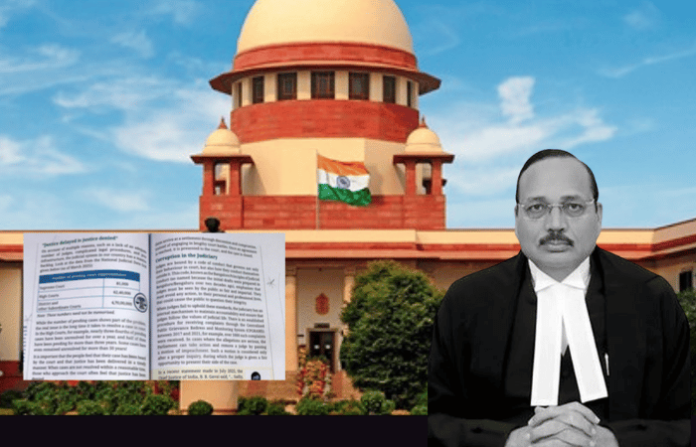
On Wednesday, Justice Surya Kant, the Chief Justice of India, strongly objected to a Class 8 NCERT textbook’s mention of judicial corruption. This has sparked a more in-depth constitutional discussion regarding the proper balance between institutional legitimacy and the freedom to criticise public institutions, rather than just school curricula.
The problem started when the Supreme Court received complaints about sections in an updated NCERT civics textbook. It purportedly describes judicial systemic problems like corruption, backlogs of cases, and a judge shortage.
The chief justice emphasised that the judiciary cannot be permitted to be disparaged in instructional materials. He also said the court may look into the case.
The issue started when Senior Advocates Kapil Sibal and Abhishek Manu Singhvi brought up the matter. They brought up the social science textbook sections in front of the CJI. Ur purportedly described judicial corruption while talking about institutional functioning and governance.
CJI on the Matter
“Politics, bureaucracy, and other things have been omitted by NCERT. Nothing about the other sectors,” Sibal and Singhvi told ANI. “They are teaching as if it (corruption) only exists in this institution”.
The CJI acknowledged the gravity of the situation in response to their worries. “I know it quite well. We’ll hold off for a day. The entire institution is undoubtedly concerned about this. Both the bench and the bar. There are a lot of calls and texts coming in. I’m addressing the matter on my own initiative. No matter how powerful they are, I will not allow anyone to disparage the organisation,” CJI Kant declared.
The CJI notes that the section’s inclusion seemed to be a “calculated and deep-rooting thing”. He also said, “We will not say anything more than that. As the institution’s leader, I’m aware of it and taking action already.”
Sibal had already criticised the section’s inclusion and questioned the NCERT about it on Tuesday. “There is a section on judicial corruption in the NCERT Class 8 Textbook. What about the widespread corruption of public officials, ministers, investigative organisations, and governments? Brush then under the carpet”. Sibal had scrawled on X.
The addition of a section on corruption represented a major change from the preceding NCERT Social Science textbooks for class 8. It concentrated on the function of the judiciary and the organization of Indian courts.




Be First to Comment