
Following the US Supreme Court’s decision to overturn Donald Trump’s global tariffs, there is currently uncertainty about the duty that Indian goods must pay. Like the Chaos caused by Trump’s preferred tariffs last year, the move has created more questions than answers. Just days after Trump lowered tariffs to 18% from 50% as part of an unsigned trade deal, exporters in India must once again adapt to a changing objective. The main question at this point is whether India will be required to pay a tariff of 18% 10% or 13.5% (plus the 3.5% pre liberation day charge).
Key Parts of the US Supreme Court’s decision on the Trump tariff
- In the majority opinion of the Supreme Court’s decision, Chief Justice John Roberts claimed that the president had overreached his authority. Any “extraordinary assertion” of such power necessitates “clear Congressional Authorization,” which Trump lacked, according to Roberts. The decision puts an end to the administration’s application of legislation that has traditionally been intended for asset freezes or sanctions against enemies rather than broad trade taxes.
- Without consulting the US Congress from had imposed levies on imports from almost all trading partners under the 1977 International Emergency Economic Powers Act (IEEPA). This included allies from Canada to India, which was formally subjected to a 50% tariff rate before a trade deal. Then it lowered to 25% for the time being and 18% in the near future. Congress, not the president, is expressly granted the power to impose taxes and tariffs under the U.S. Constitution.
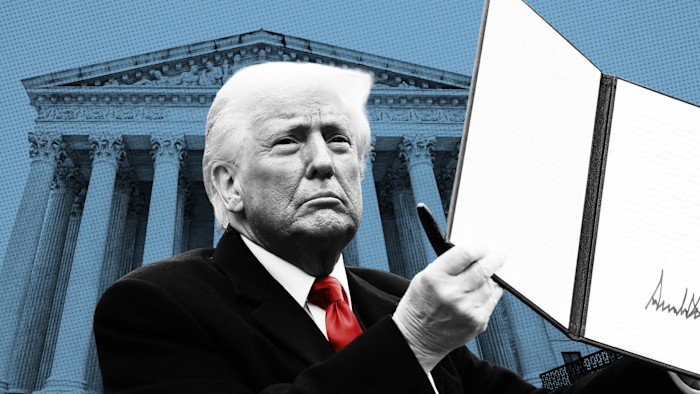
- Trump acted swiftly to maintain his trade objectives after the US Supreme Court invalidated many of the tariffs he had imposed last year. Hours after the Supreme Court verdict, he signed an executive order on Friday establishing a 10% global tariff on foreign goods.
- A white house information sheet states that the permission is scheduled to go into effect on February 24th at 12:01 a.m. Washington time.
- Scott Bessent, Trump’s Treasury Secretary, stated that there would be virtually no change in tariff revenue in 202,6. Not due to the additional 10% Levies and potential higher tariffs under the section 301 and fair practices statute and section 232 national security law


Be First to Comment