
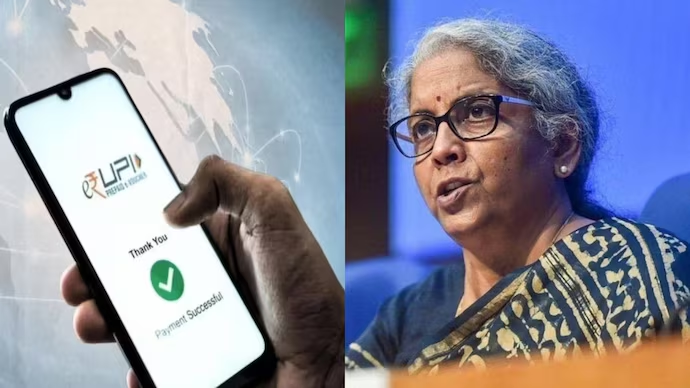
The Unified Payments Interface (UPI) ecosystem might be poised for a big transformation as authorities examine putting charges on some higher-value merchant transactions. However, minor payments, and person-to-person transfers outside the price structure stay untouched.
The Finance Ministry has stated that UPI transactions of up to 2000 rupees cannot be subjected to any direct or indirect fee by banks or system providers. The change effectively safeguards the vast majority of UPI transactions from charges, since about 96% of transactions by volume fall inside the 0-2000 rupees threshold.
In a Gazette notification released on September 14th, the Department of Financial Services under the Ministry of Finance mentioned two electronic payment options. “Debit card powered by RuPay” and UPI transactions up to 2000 rupees.
The announcement expressly prohibits banks and system providers from charging up to 2000 rupees in direct or indirect fees on UPI transactions. Payments made with RuPay-enabled debit cards are also covered.
What happens if you pay at a store using UPI?
This is where the new framework comes into play. There won’t be an MDR if you pay a merchant up to 2000 via UPI.
The payment is still free if you scan the QR code and pay 500, 1000, or 2000 rupees. Customers won’t be charged for these transactions, according to the government.
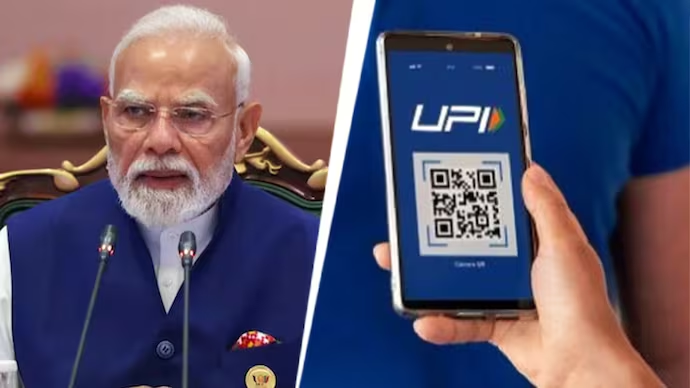
What will happen if the amount paid exceeds 2000 rupees?
MDR will be applicable for some merchant transactions above Rs 2000. A fee in the payment ecosystem is known as the Merchant Discount Rate, or MDR. According to the government, it is neither a tax nor money collected by the NPCI.
A 0.4% MDR will be applied to merchant transactions over 2000 rupees under the new system. The MDR would be limited to 300 rupees for any transactions totalling 75000 rupees or higher. Customers will not be required to pay MDR, according to the government. Additionally, banks have been encouraged to make sure that retailers do not pass the MDR cost to consumers.









Be First to Comment